


Assessing Assessment
I am finishing my fourth term with the American College of Education, and one of my classes is focused on assessment strategies. I am not fond of assessments as I feel that they do not help the students or the teachers, but after taking this class this term, I see them differently. In the following sections of this entry, I will discuss various assessments and the different factors that we need to consider to provide a balanced assessment system for our students and produce lifelong learners ready for this technology-driven and globally competitive environment.
Assessment and Lesson Objectives
Assessment is a process of evaluating the individual's knowledge or skills (Popham, 2020). Educators have been using assessment as a source of students' grades for the longest time. Stiggins (2014) brought a new purpose for assessment: to use assessment to help students reach their dreams. The results of assessments should not only focus on the numerical grade the students get but also identify the things that students can improve. Assessment results should be processed and interpreted and used the interpretation to modify the instructional method. Analyzing the assessment allows teachers to see the areas that need improvement. There are different types of assessments, which are formative, summative, and standardized assessments.

Formative assessments are classroom level, and the result of these assessments are used to modify instructional methods. Stiggins (2014) explained that the teacher at the classroom level should decide the changes, and they do not need to wait for standardized test results to modify their instructional method. Waiting until the end of the year assessment to change teaching strategies for the next school is incorrect. Educators should fix the problem immediately before it gets bigger and do more damage to the students and the school. The summative assessments are usually a grade-level decision, and this is the assessment that should be graded. Before educators give a summative assessment, the students have already received different types of formative assessments, and the result of the formative assessments gives an idea to the teacher how prepared their students are. At the end of the year, state testing allows teachers to see what the students learned from the school year. The result of the state testing can be used at the school or district level when planning for the next school year. These results will allow them to develop an intervention plan to ensure students receive a high-quality education.
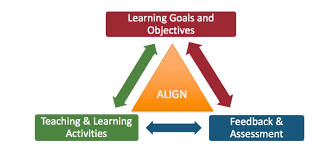
Assessments are the tool to reveal what the students learned, goals give direction to the students and teachers on what they want to achieve, and instructional strategies are the ways to meet the objectives. Assessments should be aligned with the lesson objective and instructional strategies (Popham, 2020). Educators should develop assessments after setting objectives, and the standards set by the state or school will be the basis of the purposes. When creating an assessment, educators should also think if they as using the assessment to build knowledge or measure the students' understanding.
Open-Ended, Selected-response or Authentic/Performance Assessments

Various forms of assessments are used in the classroom, and I do not have a favorite as I choose the type of assessment appropriate to the subject I am teaching. I teach Math and Science; most of the time, I use selected-response for summative assessments. It is my way of training or familiarizing them with standardized testing. I use open-ended assessments mostly in science class, as the goal of this class is to activate their curiosity, and using a selected response will not meet the objective of a science class. I tried to use open-ended assessments in Math as formative assessments, and the question primarily focused on how they could solve the problem. Authentic or performance assessments are becoming more popular nowadays. I love using authentic assessments as it removes the test anxiety factors that students have when taking a traditional assessment. Students prefer having an authentic assessment as they can apply themselves, and there is no right or wrong answer. One of the most important things when using authentic assessment is having a rubric and explaining the rubric to the students. Balch et al. (2016) emphasized that teachers should explain and clarify the rubric's elements, so the students will not be confused. I usually use authentic assessment in Science throughout the year, as it allows hands-on experience for the students. At the end of the school year, I use authentic assessment in my Math class in preparation for their career decision in high school.
In my opinion, there is no BEST form of assessment as it always depends on the class and the objectives and state standards they need to follow. The important thing is when deciding which form of check is it is aligned with the objective, and it measures what is supposed to evaluate
Grade for Effort

My students ask me a common question whenever we are working on classwork: whether it is graded. Not all assignments are graded, and I will not lie to my student and tell them that it is graded. I tell them that I need them to prove they know how to answer it, so when it comes to grading week, I have proof that they see the content in case they missed days in my class. Students nowadays do not make any effort in school because they know they will pass and move to the next level. I believe teachers should grade formative assessments like daily practice for 30%, and quizzes are a different grade. The problem I see with the students here is they are afraid to make mistakes that they will not try, and this cause some behavioral issues in the classrooms. If students know that teachers will grade the effort, it will increase their self-esteem, which will help them have self-confidence and try more. Attendance and behavior are not part of the grading system, which dramatically affects why students are not accountable for coming to school or behaving in class because they are not held liable. Showing up in class helps them to learn about the topics. Students who are not present in school cannot catch up with the discussion, leading to them not trying at all. In most school districts, the lowest grade they will give a student is 50% for not doing anything, making me wonder why we cannot grade students' efforts. When students do not finish their work, I ask them if they want me to grade whatever they finish than nothing, which works well with my students, and I noticed that they are more motivated to learn than me forcing them to complete their work.
Balancing the System with Participation

When I was in the Philippines, our grading system included recitation grade, which is about 10% of the grade. In America, the grading system is only divided into two categories, minor and major grades. The participation grade can be participation in a group project or class. The purpose of school is to teach students to socialize, but not having a participation grade fails us to teach our students to communicate appropriately. Participation grade is subjective, and it is a way to balance the assessment system. Most educators encourage helping mental health students, but we do not incorporate it with our grading. Participation grade focuses on how students communicate and express their feeling in school. Still, we are encouraged to prioritize mental health while putting the students on standardized tests, which is entirely objective. Stiggins (2014) emphasized that we need to produce lifelong learners, and for that to happen, we need to prepare our students on how they will participate in the real world outside the classroom.
Growing with Portfolio

A portfolio is a compilation of an individual’s work (James & Casidy, 2018). Teachers are using portfolios to track students’ growth and for the students to see their improvement through the course. I have not used a portfolio in my classes here in America because students come and go, and I find it challenging to track their growth. As an adult, I used a portfolio for my formal evaluation to get my teaching certificate and in one of my classes. I found it beneficial to keep a portfolio during my formal evaluation as I can track which factors I need to improve. It allowed me to document my students’ work as proof that I am using differentiated instruction in my class. There are different types of portfolios, digital and traditional. I believe it would benefit students to have a portfolio because they can self-assess their work and improve it. They have an example on hand and do not commit the same mistakes. As an adult, I share with my students those employers look for applicants’ portfolios to see their achievements—training students on how to keep a portfolio. I had a student last school year who kept all her classwork in my class, and she said that she knew that she improved with my style and not because of the grades. She showed me her work in quarter one, where I have a lot of comments, and the quarter four work with no correction. Portfolios allow students to self-assess their growth, which is essential as we should be competing with ourselves.
Graphs in Interpreting Assessment Results

Graphs are the visual representation of numbers in research, and it allows the audience to understand the data that is presented to them (Ducker, 2022). Most standardized assessments like the state-testing and MAP test produce a graphical representation of the assessments results. School district avail online software that gives interpretation about the assessment results. Teachers should know how to interpret the graphs and use the assessment result for instructional planning.

My previous school district was using the program Rally and it is showing what will be the possible performance of our students in the state testing using the information from the result of MAP testing. The graphs were able to help us understand the results and figure out the areas where students might probably have problems during testing.

Graphs also allow students to see their improvement. The last district that where I worked used DreamBox and students were able to see the result in graphs, and they know if they are just a little bit above the passing grade. The graph showed the students their level and they became competitive with the other students that helped them to improve their academic performance.
In my opinion…

The assessment strategies class allowed me to look at assessments differently. Before, I saw assessments as one of the requirements that I needed to do to get a grade for my students' report cards. Now, I see assessments as a tool to help me know and guide my students to be successful and for me to be a better teacher. Most teachers do not like assessments as they are a punishment to the students; about ten to twenty percent of school days are allotted for testing; these are MAP, Benchmark, and the end-of-the-year state testing. Students are getting tired of taking assessments, and teachers do not have time to apply the intervention plan they develop before the next test. Our educational system is too focused on the objective type of assessment that we forget that children need to have balance. Including participation and effort grades will allow students to be lifelong learners. Educators should include subjective grades in school. We encourage focusing on mental health in school, but we do not prepare our students to be socially-equipped citizens, affecting their mental state. The assessments should be a tool to help teachers and students and not a tool to evaluate the effectiveness of the teachers in the classroom. Stiggins (2014) emphasized that teachers should align assessments and objectives, but using assessment results from students' standardized tests to measure teacher effectiveness is not aligned. The students are not held accountable for the outcome of their tests. The grading system should have modifications and be divided into more categories to keep students' accountable, which will help with the behavioral problems in the classroom. The teacher-student relationship has a positive effect on the academic achievement of the students. Still, I believe including the parents in their children's activities through feedback will give a better result. For the past three years, I have ensured that I have a great relationship with my students and their parents. Parents and teachers should work together for the benefit of the students.
Reference:
· Ducker, M. J. (2022). Analyzing items using test specifications [Unpublished manuscript]. American College of Education.
· James, L. T. & Casidy, R. (2018) Authentic assessment in business education: its effects on student satisfaction and promoting behaviour. Studies in Higher Education 43(3). 401-415. https://doi.org/10.1080/03075079.2016.1165659
· Popham, W. J. (2020). Classroom assessment: What teachers need to know (9th Edition). New York, NY: Pearson
· Stiggins, R. (2014, March 4). A new vision of excellence in assessment [Video]. https://youtu.be/XHX2jnKNiyw



Comments